
RAIB says CCTV from earlier trains shows a track irregularity where the Southern service left the rails near Lewes, and passengers reported rough riding.
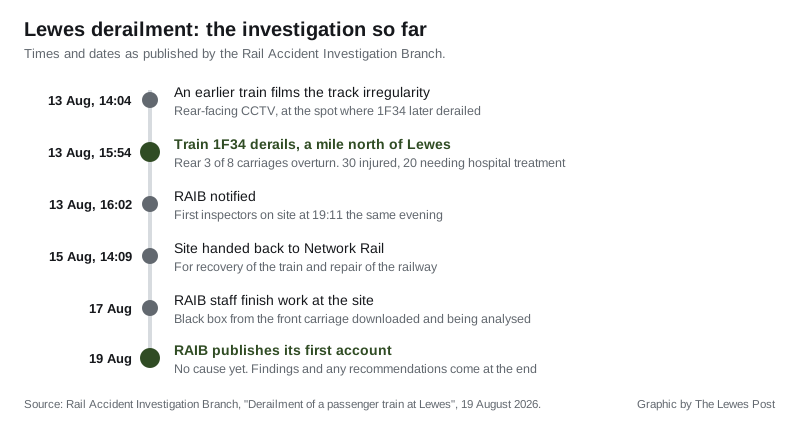
Something was wrong with the track before the train got there. That is the clearest line in the first detailed account of the Lewes derailment, published on Wednesday 19 August by the Rail Accident Investigation Branch.
Investigators say camera footage from trains that passed the spot earlier on 13 August already shows a fault in the shape of the track. Passengers on other services have since told RAIB they felt rough riding at the same place.
The accident happened at about 15:54 on Thursday 13 August, around a mile north of Lewes station. Train 1F34, the 14:24 from London Victoria to Eastbourne, was formed of eight carriages. The rear three came off the rails and overturned onto the embankment. The front five stayed on the track.
RAIB has also revised the casualty figure upwards. Around 150 people were on board. Thirty were injured and 20 needed hospital treatment, some with serious injuries. The ambulance service had put the hospital figure at 18 in the days after the accident.
What the evidence shows so far
RAIB’s preliminary findings, all from its own published account, are:
- The train was doing about 65mph as it approached the point of derailment. The line speed there is 70mph.
- The driver applied the brakes as the train passed the point of derailment, and it began to slow.
- Marks on the rails are consistent with the wheels of the rear carriages climbing over the rails.
- Forward-facing CCTV from the train itself, and forward and rear-facing CCTV from earlier services on the same day, show a track geometry irregularity on the immediate approach to the derailment point, before the accident.
- There was evidence of previous track maintenance in that area.
- Since the accident, RAIB has received several reports of rough riding at that exact location from passengers on other trains.
The derailment was on the Down Lewes line, which carries trains away from London, between Cooksbridge station and Lewes Tunnel, at 48 miles and 60 chains. The train was two four-carriage Class 387 units coupled together.
The heat and the embankment
The weather is part of the investigation. RAIB records that 13 August was hot and sunny with little wind, and that the nearest weather station, at Brighton City Airport, recorded around 27C at the time. It fell within a sustained hot, dry spell.
That matters because of what the railway is built on there. The embankment is clay, sitting on alluvial deposits of loose clay, silt, sand and gravel. Both move as their water content changes. RAIB says there is no evidence at this stage that a significant embankment slip happened before the accident, but there is evidence that some movement had taken place previously.
What the investigation will examine
RAIB has set out what it will look at:
- the exact mechanism by which the train derailed
- the state of the track, and how it was inspected and maintained
- the condition of the embankment, including hot weather, nearby structures and vegetation, and how it was inspected and maintained
- the weather in the area on the day, and in the weeks and months before it
- how effective the industry’s hot weather measures are
- the condition of the train, and how the rear three carriages performed in the crash
- the emergency response
- whether previous safety recommendations were acted on
The investigation is independent of Network Rail, Southern and the regulator, the Office of Rail and Road. RAIB will publish its findings and any safety recommendations at the end. It gives no date for that, and it warns that details in this first account may change as the work goes on.
The line is still shut, and the date may move
RAIB released the site to Network Rail at 14:09 on Saturday 15 August so repairs and recovery could start. Its own staff stayed until Monday 17 August. Lifting the overturned carriages needs a rail crane, and they then go by road to secure storage.
National Rail’s disruption page, updated at 10:00 on Wednesday 19 August, says the railway between Haywards Heath and Lewes stays closed until at least the end of Wednesday 26 August, and that the closure is likely to continue beyond that date while the recovery goes on. Southern says engineers cannot assess the damage properly, or start repairs, until the train has gone.
Current arrangements:
- Replacement buses run between Haywards Heath and Lewes, calling at Plumpton and Cooksbridge.
- There are no direct trains from London to Eastbourne or Hastings. For Eastbourne, change at Brighton. For Lewes, Plumpton or Cooksbridge, take the bus from Haywards Heath.
- Brighton to Seaford is running normally, and extra carriages have been added between Brighton and Eastbourne.
- A separate landslip between Polegate and Eastbourne now means a speed restriction rather than buses, so those journeys take longer.
- Allow at least 60 minutes extra, and check again the day before you travel.
What it means for you
If you commute from Lewes, Cooksbridge or Plumpton, plan on the bus into September rather than the 26 August date. That date is the earliest, not a promise, and the operator has now said in writing that it expects to pass it.
If you were on train 1F34, or on a train that passed that spot on 13 August, RAIB is the body that wants to hear it. Its account specifically cites passenger reports of rough riding at the location, so accounts from travellers are feeding the investigation.
If you read that the cause is known, it is not. RAIB has published what it has recovered, not a conclusion. The black box from the front carriage has been downloaded and analysed, but the recorders on the derailed carriages will only be reached during the recovery.
Our earlier report on what runs and how refunds work is still the practical guide, and the day-to-day picture is kept in Lewes roadworks and travel.
Have your say